Cricket Head Protection History: From Cap to Helmet
Cricket head protection history explains how caps, improvised padding and purpose-designed helmets served different needs, and what to look for in old kit.
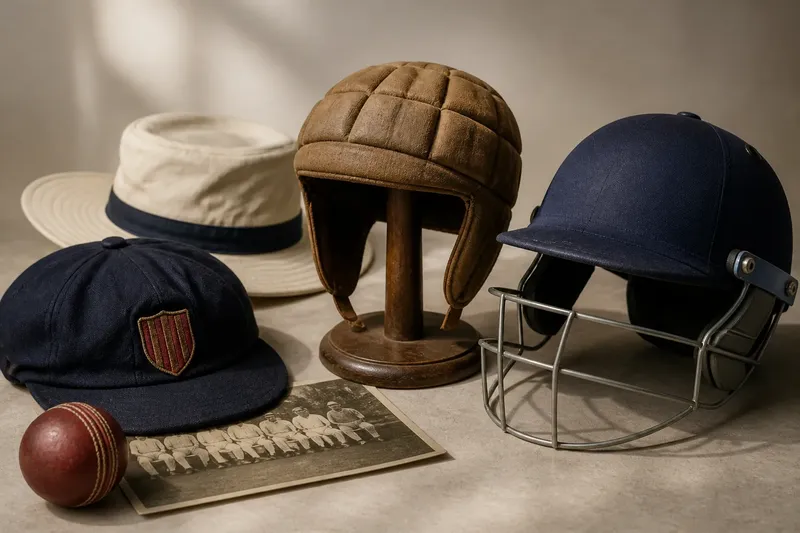
In an old team photograph, a batter’s cap sits neatly above the eyes; in a later image, a grille frames the face. Cricket head protection history is visible in that change, but the path from customary headwear to specialist equipment was not a single, tidy invention.
Caps and helmets answer different needs. A cap is clothing; a cricket helmet is protective equipment designed for batting. The years between them included improvised approaches, but broad claims about who first used them or exactly when helmets became common need reliable historical sources. The design changes themselves offer a clearer way to understand the shift.
Caps were made for shade and team dress
Traditional cricket caps and broad-brimmed hats helped shade the face and eyes and formed part of a player’s on-field appearance. Their cloth crowns and brims were not designed as impact barriers. A familiar shape, even one worn by generations of players, does not become protective equipment simply through long use.
That distinction helps when reading old photographs. Look at the materials and construction, not just whether a player’s head is covered. Soft fabric and a brim indicate ordinary headwear; they do not show that the item was designed to protect against a cricket ball.
Improvised padding showed a change in concern
Before dedicated helmets were used, some players sought extra protection through adapted headwear or padding. This broad description is safer than assigning a precise date or naming an inventor without a source. Such adaptations suggest that some players wanted more than shade, while leaving open how much coverage or stability each arrangement provided.
Improvised padding is like putting a cushion against one part of a door: it may soften contact there, but it does not make the whole structure serve a new purpose. In cricket, an added layer could address one area while leaving questions about fit, movement, vision and exposed parts of the head. It should be understood as an adaptation, not as equivalent to a helmet.
Helmets brought several design needs together
A purpose-designed cricket helmet combines a shell, internal padding and a face guard. These parts work as a single item: the shell and padding form the head covering, while the grille helps protect the face without blocking the batter’s view of the bowler and ball. The design must allow a stable fit and usable sightlines as the player moves.
This is the meaningful development in the equipment story: head protection became a dedicated design task rather than an add-on to ordinary clothing. A helmet is not simply a harder cap. Its shape and components respond to the specific demands of batting.
Say a club batter has worn a cap for shade but wants purpose-designed protection when facing bowling. The club provides a cricket helmet with a shell, padding and grille, and the batter wears it at the crease. The observable change is that the player’s headwear now has components designed for batting protection, while the cap remains useful for ordinary fieldwear.
Use these clues to read the equipment
- Check whether the item has a rigid shell; if it does, treat it as a possible piece of protective equipment and inspect its label and instructions, but if it is soft cloth, treat it as ordinary headwear.
- Check for internal padding; if padding is integrated with a shell, look for the maker’s model and guidance, but if it is a loose added layer, do not assume it has helmet-level design.
- Check whether a face guard is attached or designed to fit the item; if it is, inspect the connection and fitting instructions, but if it is absent, do not infer that the face is covered.
- Check whether the grille leaves a clear view through its openings; if the view is obstructed, follow the manufacturer’s fit guidance or seek advice from a qualified cricket-equipment specialist, but if visibility is clear, continue checking the remaining fit points.
- Check whether the helmet sits securely when worn as instructed; if it shifts or feels unstable, stop and adjust it according to the maker’s directions or seek specialist advice, but if it remains stable, check the label and condition before use.
- Check the label and manufacturer instructions for intended use and applicable requirements; if these are missing or unclear, ask a qualified equipment specialist or relevant cricket organisation, but if they are clear, follow them rather than relying on the item’s appearance.
These clues help identify design intent; they are not a substitute for checking a helmet’s condition, fit, instructions or suitability under local rules. If you are unsure about equipment for play, ask a qualified cricket-equipment specialist or the relevant cricket organisation.
What do readers ask about cricket head protection?
Why did players move beyond caps?
Caps were made for shade and team dress, not as impact barriers. Players seeking dedicated head protection needed equipment designed around batting rather than an ordinary cap.
What distinguishes a helmet from padded headwear?
A cricket helmet brings a shell, internal padding and a face guard together in one design. A padded cap or other adaptation may add material, but its appearance alone does not establish that it has the same design or intended use.
Why does a cricket helmet have a grille?
The grille helps cover the face while leaving openings for sight. Its position needs to work with the helmet’s fit and the batter’s view of the bowler and ball.
Did helmets replace caps?
No. Caps and hats remain ordinary cricket headwear, while helmets are designed for protective use in relevant playing situations. One does not make the other obsolete because they serve different purposes.
Dates need sources, but design shows the shift
A precise chronology of early adaptations and the first cricket helmets should be supported by reliable historical records, not inferred from a general progression. When examining a museum display or old photograph, note what is actually visible: the material, construction, added padding, shell and face guard. Those details help distinguish customary headwear from equipment designed specifically for batting.
Cricket head protection history is most useful when it separates evidence from inference. A cap can show how players dressed; an adapted layer can suggest an attempt to address risk; an integrated helmet shows a design built around protection, fit and vision. If you handle an old item, record its visible features and seek a specialist’s identification before assigning it a date or inventor.