The Parts of a Cricket Bat and What to Check on Each One
The parts of a cricket bat are easier to inspect with a clear checklist; learn what to look for from the grip to the toe and when to seek repair.
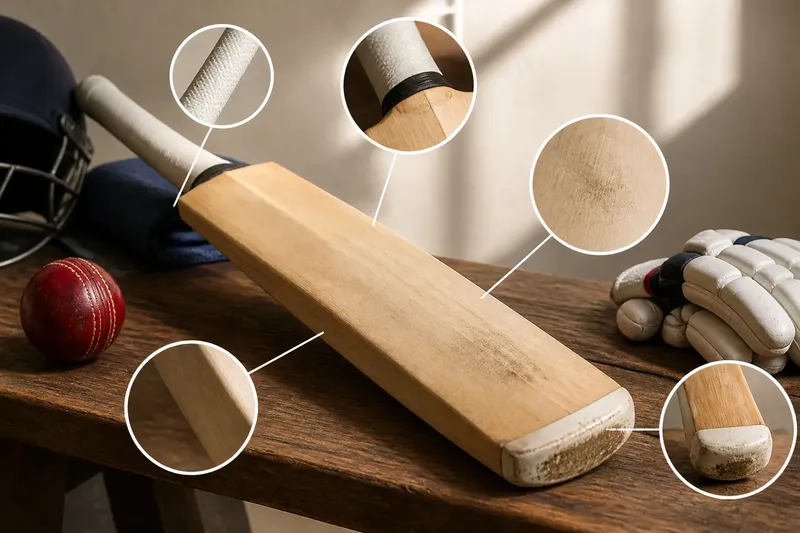
You set a cricket bat on a changing-room bench and notice a loose strip of grip, a pale mark on the face and grit packed around the toe. Knowing the parts of a cricket bat helps you describe each sign clearly and decide what to do next.
Inspect a cricket bat from handle to toe
Start with the bat dry and still. Use good light, and turn it slowly rather than pulling at coverings or flexing the wood. Work down the bat in order so you can connect each observation to its location.
- Grip: Check for a split, slick patch or movement on the handle. If the grip is torn or slips, replace or refit it; if it is secure and comfortable, leave it in place.
- Handle and splice: Look where the handle enters the blade for a visible gap, crack or movement between the parts. If the joint appears loose or damaged, stop using the bat and ask a bat repairer to assess it; if it looks sound, continue the inspection without removing its covering.
- Shoulders: Compare the two sides of the taper below the handle for fresh splits or a pronounced change in shape. If you see either, seek a repairer’s advice; if the outline is intact, note any small asymmetry without treating it alone as damage.
- Face: Look across the striking surface for raised splinters, a dent or a line that cuts into the wood. If a line looks like a split or has lifted wood, stop play and get professional advice; if it is a shallow surface scuff, clean it gently and check it again after use.
- Back, spine and fuller: Look for a new crack or separation beside the raised spine and the channel known as the fuller. If either appears split, have the bat assessed; if the contours are intact, record their shape as part of the bat’s profile.
- Edges: Check both side boundaries for a fresh split, lifted wood or a dent that reaches in from the face. If damage appears to enter the wood, seek a repairer; if the edges are intact, do not judge balance by their size alone.
- Toe and toe guard: Look for splintering, a worn patch, a lifting guard or signs that moisture has reached exposed wood. If the guard is lifting or the wood looks damp, follow the maker’s care guidance and ask a repairer if damage is visible; if the toe is intact, wipe off dirt and store the bat dry.
Read the handle, joint and shoulders together
The handle is the narrow section held by both hands. It is commonly made from cane and covered with a rubber grip. A round or oval cross-section changes the way the handle sits in the hands, but neither shape dictates a particular technique.
The splice is the junction where the handle enters the blade. A grip or binding may hide part of it, so inspect only what you can see. Do not pull coverings apart to look underneath. If the handle moves independently of the blade or the joint shows a crack, stop using the bat until a qualified bat repairer has examined it.
Below the splice, the shoulders taper into the wider blade. A smooth transition is easy to describe, while a fresh split or a sudden change in shape deserves attention. Small differences in a handmade outline are not, by themselves, proof of damage.
Describe the blade without judging it by outline
The blade is the broad wooden section used to meet the ball. Its front is the face; the opposite side is the back. The spine is the raised ridge along the back, and the fuller is the channel beside it. Edges mark the sides between face and back.
The face may be flat or slightly curved, and the edges and spine show where wood sits across the blade. Think of a loaf of bread: its outside shape gives you a view of the material’s arrangement, but does not tell you how the loaf feels to hold. In the same way, a bat’s outline alone cannot settle how it will feel in your hands.
Separate surface marks from signs of structural damage. A shallow scuff is on the surface; a crack splits the wood and may have raised fibres or extend towards an edge, toe or splice. Do not force a mark open to investigate it. If you cannot tell whether it is a crack, stop play and ask a bat repairer.
Use grip, blade and toe observations to describe balance
Balance is a whole-bat sensation, not a separate part. The handle, blade profile, spine, edges and toe all contribute to how the bat feels when lifted and moved. A large-looking edge does not, by itself, show where the bat’s weight sits.
Say you have a bat with a secure oval handle, a sound face and no visible damage, but it feels awkward in your usual stance. Hold it in that stance and make a familiar, controlled practice movement. If the grip turns in your hands, note the handle or grip; if the hands stay settled but the blade feels slow to move, describe the sensation as blade-heavy rather than blaming one visible feature. This invented example gives you a more useful description to share with a coach or repairer.
Which bat signs need attention?
How can you tell a scuff from a crack?
A scuff sits on the surface, while a crack splits the wood and may have lifted fibres or a visible opening. If you are uncertain, stop using the bat and ask a qualified bat repairer to assess it.
What should you do if the handle moves?
Stop play if the handle appears to move independently of the blade or the splice looks damaged. Do not try to pull off the grip or repair the joint yourself; ask a bat repairer for advice.
What does a lifting toe guard mean?
A lifting guard can leave the wood exposed, but it does not reveal the full condition beneath. Keep the bat dry, follow the maker’s care guidance and ask a repairer to check for visible damage or moisture concerns.
Keep your inspection notes specific
After checking the bat, write down the location and appearance of anything that stands out: for example, “slick grip near the lower hand” or “shallow dent on the face”. The parts of a cricket bat give you precise words for a coach or repairer, and a clear note helps distinguish a comfort issue from damage that needs attention.
Before the next session, check the grip, splice, face and toe in good light, then put the bat away dry. If a mark looks structural or the joint feels loose, leave the bat out of play until a qualified repairer has assessed it.